


 Resources
Catheter Braiding vs. Catheter Coil Winding: How to Choose the Right Shaft Reinforcement
All Resoures
05 Nov 2026
Catheter Braiding vs. Catheter Coil Winding: How to Choose the Right Shaft Reinforcement
A comparison of flexibility, torque response, kink resistance, pushability, and catheter manufacturing considerations
Catheter braiding and coil winding are the two most common ways to reinforce a catheter shaft: a braid interweaves wires in a crossing mesh, while a coil winds wire in a continuous helix. Reinforcement plays a central role in catheter performance. In reinforced catheter shaft design, the structure beneath the polymer jacket influences how a device tracks through anatomy, responds to rotation, resists kinking, and supports the intended procedure. Each shapes the shaft’s mechanical behavior differently.
In brief: Catheter braiding typically provides stronger torque transmission and directional control, while catheter coiling often supports greater flexibility, kink resistance, and hoop strength through tight and tortuous bends. The best reinforcement method depends on the intended use and procedural requirements, along with shaft profile, wall thickness, and polymer layers.
Catheter Braiding vs. Coil Winding at a Glance
What Is Catheter Braiding?
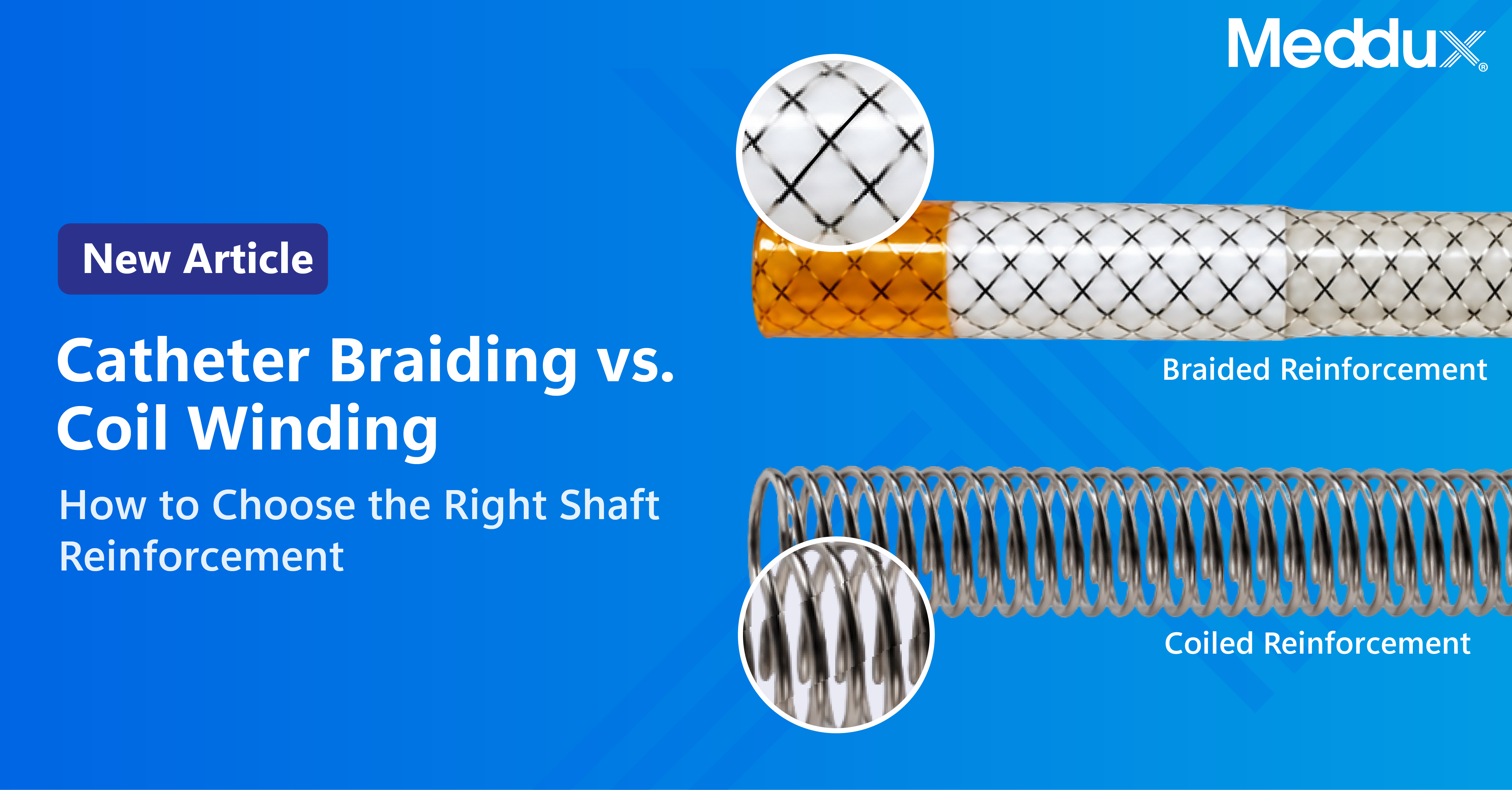
Braided reinforcement is created by interweaving multiple wire carriers around an inner liner in a crossing pattern. Common reinforcement materials include stainless steel, nitinol, tungsten, and other specialized alloys selected to match the device's mechanical and dimensional requirements. Together, the wires form a mesh-like braided catheter shaft that supports the catheter wall in multiple directions.
Because the strands intersect, a braid can provide strong torque transmission and predictable distal response when the proximal shaft is rotated. Braid density, pick count, braid angle, wire geometry, and materials can be adjusted for the intended application. Higher pick density increases coverage and radial support but reduces flexibility, while lower pick density creates a more open, flexible braid.
Catheter braids may use half-load, diamond-pattern, or full-load constructions. Half-load braiding uses fewer carriers for greater flexibility, full-load braiding uses the full carrier complement for more coverage, torque response, and pushability, and diamond (one-over-one) patterns can be tuned through braid angle and pick count to balance flexibility, torque, and support. Triaxial braids add longitudinal wires along the shaft axis for greater axial stiffness and pushability.
At Meddux, we can support most common braiding configurations with a stock inventory of stainless steel wire and some specialty alloys, in full-load, half-load, diamond, and triaxial patterns, both reel-to-reel and discrete-part.
Learn more about Meddux catheter braiding capabilities.
What Is Catheter Coil Winding?
Catheter coil winding uses wire wound helically around an inner liner, much like a spring. In coil-over-core construction, the wire is wound directly onto the core or liner. In point winding, the coil is produced as a spring preform and then placed onto the core, which imparts lower radial tension. Either way, the coil provides circumferential support while its turns move relative to one another as the shaft bends.
Coiling is often selected when flexibility, hoop strength, and resistance to flattening or kinking are priorities. Coil pitch, wire dimensions, material, and changes along the shaft can be tuned for the application, including small-profile and microcatheter designs.
Meddux has the ability to perform coil-over-core winding and point winding. We can handle extremely small wire diameters (0.0007 in.) and hold pitch tolerances of approximately ±0.0002 in. over lengths up to about 1,800 mm. We also can vary pitch and wire diameter along the length.
Learn more about Meddux catheter coil winding capabilities.
Key Performance Differences
Torque response
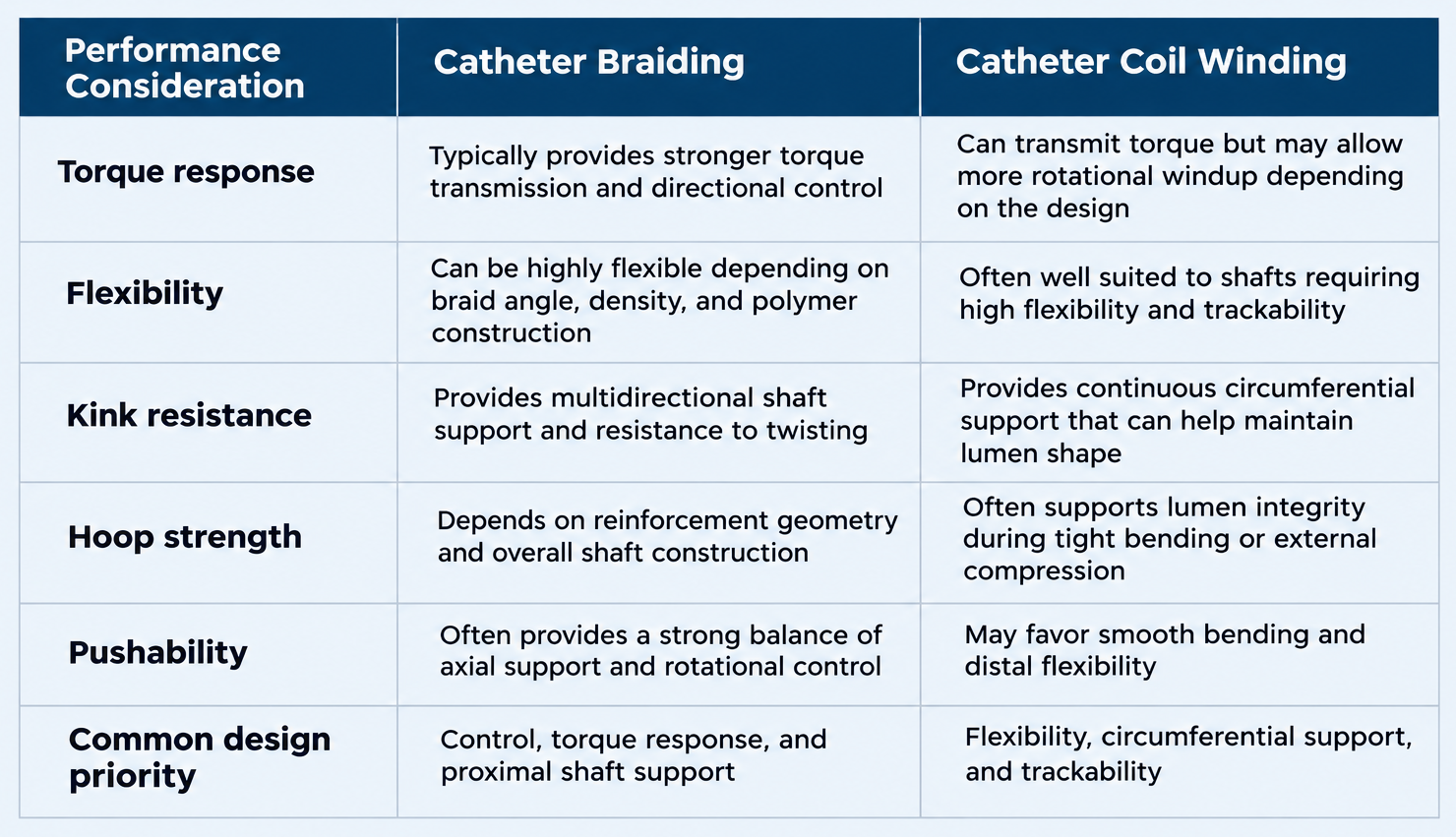
Braids generally excel when rotational control matters. Their crossing filaments distribute torsional forces through the shaft, so movement at the hub translates more directly to the distal end. Coils can transmit torque but may permit more rotational windup.
Flexibility and trackability
Coils are often well suited to curved or tortuous pathways because they bend with relatively low resistance while maintaining circumferential support. Braids can also be highly flexible, depending on braid angle, density, and the surrounding polymer.
Kink and compression resistance
Both constructions improve kink resistance but respond differently under load. A coil's continuous circumferential support helps the lumen hold its shape during bending or compression, while a braid's interlocking network adds resistance to elongation and twisting. Final performance depends on how the reinforcement interacts with the liner, jacket, wall thickness, and transition zones.
Pushability and support
Pushability describes how effectively force at the proximal end advances the catheter. Braided shafts balance axial support with rotational control, which helps in devices that must be steered or positioned precisely, while coiled shafts favor smooth bending and distal flexibility.
Design and Manufacturing Considerations
Reinforcement selection also affects manufacturing. Braiding requires control of wire tension and braid parameters and may use continuous reel-to-reel or discrete-part processing. Coil winding requires similar control of pitch, spacing, wire dimensions, and tension. Small changes in any of these can shift flexibility, stiffness, hoop strength, kink resistance, and the finished catheter profile.
Reinforcement must also bond with the surrounding polymer layers, withstand downstream processing, and account for radiopacity, fatigue life, corrosion resistance, and the dimensional limits of the target application.
For a closer look at how these variables play out, Meddux and MSI compared predicted and measured performance across braid patterns, including how pattern choice affects cost, in a CathCAD white paper on Insights for More Efficient Braided Catheter Development.
Choosing Between Braiding and Coiling
Braiding is often the stronger choice when torque response, directional control, and shaft support lead the requirements. Coiling may suit designs that prioritize flexibility, lumen integrity, and kink resistance in tight curves. These are tendencies rather than rules, since wire dimensions, pattern, polymer, and shaft geometry all shape the outcome.
Hybrid Reinforcement: Combining Braiding and Coiling
Braiding and coiling are not always either-or choices. A hybrid catheter shaft can pair a braided proximal section for pushability, torque response, and directional control with a coiled distal section for the flexibility and kink resistance needed in more challenging anatomy.
Transitions between reinforcement zones need particular care, since abrupt changes in stiffness, wall thickness, or geometry can create stress concentrations, reduce durability, or produce inconsistent handling. Hybrid constructions should be tested as a complete shaft for bending, torque, pushability, kink, fatigue, and dimensions under intended-use conditions.
Questions to Guide Reinforcement Selection
- How much torque response is required at the distal end?
- Will the catheter navigate tight curves or tortuous anatomy?
- How important is lumen integrity during bending or compression?
- What shaft profile and wall thickness must the design maintain?
- Does the device require different stiffness zones along its length?
- Which materials and reinforcement geometry fit the manufacturing process?
- What bench tests will represent the intended clinical use?
Answering these questions early helps narrow the design space before prototyping, especially in small-profile and microcatheter designs, where small geometry changes can significantly affect profile and performance.
For a deeper look at reinforcement and shaft design, watch the webinar Advanced Catheter Design Techniques with Jordan Mason, Staff Process Engineer at Meddux.
Frequently Asked Questions About Catheter Braiding and Coiling
What is the main difference between catheter braiding and coiling?
Braiding uses interwoven filaments that cross around the catheter shaft. Coiling uses one or more filaments wound in a continuous helix. The crossing pattern of a braid often supports torque response, while the spring-like geometry of a coil often supports flexibility and resistance to lumen collapse.
Which reinforcement method offers better torque control?
Braided catheter shafts commonly provide more direct torque transmission because the interwoven filaments distribute rotational forces along the length of the device. Actual performance depends on braid angle, filament count, wire dimensions, polymer properties, and shaft geometry.
Can a catheter use both braided and coiled reinforcement?
Yes. Hybrid catheter shafts can use braided reinforcement in sections that need pushability and control, then coiled reinforcement in sections that need greater flexibility or kink resistance. Careful transition design keeps handling smooth across the full shaft.
Is catheter braiding or coiling better for kink resistance?
Coiling is often favored for kink resistance, but braiding can perform just as well depending on the design. Coiled reinforcement provides continuous circumferential support that helps maintain lumen shape, while braided reinforcement resists twisting and deformation through its interlocking filaments. The better option depends on reinforcement geometry, polymer construction, and wall thickness.
When should a catheter use braided vs. coiled reinforcement?
Braided reinforcement is often considered when torque response, directional control, and pushability are key priorities. Coiled reinforcement is often considered when flexibility, trackability, and lumen integrity matter more. Some designs use both in different shaft regions.
Does Meddux do both coil winding and braiding in-house?
Yes. Meddux braids most commonly in a standard 16-carrier configuration, with stainless steel wire and some specialty alloys in stock, and full-load, half-load, diamond, and triaxial patterns in both reel-to-reel and discrete-part formats. Coils are typically wound directly onto the device shaft, holding pitch tolerances of approximately ±0.0002 in. over lengths up to about 1,800 mm.
Final Thoughts
Catheter braiding and coil winding give designers two distinct ways to tune a shaft's mechanical behavior. The right choice depends on the clinical pathway, required control, target profile, and performance goals of the finished device, and prototyping and testing the complete shaft confirms that the selected approach meets its requirements.
Need help evaluating reinforcement options for a catheter program? Meddux supports catheter shaft development from early design and prototyping through manufacturing process development, including braiding, coiling, and hybrid constructions. As an ISO 13485-certified CDMO with Class 7 and Class 8 cleanrooms in Boulder, Colorado, Meddux can take your program from reinforcement strategy to production. Contact Meddux to discuss your design and manufacturing requirements.
Explore Meddux catheter reinforcement capabilities:
Related reading:
Steerable Catheter Design - Josh Goetz, Director of Engineering
The Role of Microcatheters in Stroke and Neurovascular Therapy - Jordan Mason, Staff Process Engineer

Related Resources


— Connect
Your Medical Guide From Concept to Commercialization
Whether you need targeted engineering support, manufacturing process development, or a full development and manufacturing partnership, Meddux provides a modular approach tailored to your program requirements.
Connect with our team to discuss how we can support your next medical device program, from user-centered design through commercial manufacturing.


Capabilities

Markets
Our Approach
About Us
Resources
© 2026 All rights reserved
made by