


All Resoures
17 Sep 2026
Polymer Material Selection in Medical Devices
Materials are the physical backbone in every product, and advancement in materials science and chemical engineering have been a driving force behind many of the technological innovations in medical devices. Broadly, medical device materials can be categorized as metals, polymers, ceramics, and composites. This article explores factors to consider when selecting polymers for use in the development of new medical device products. The vast array of medical products in use today would simply not exist without polymer technology and the manufacturing processes to configure them into their finished form and properties.
Defining Device Requirements
The clinical intended use is the ground floor for material selection. Anticipating the tissue contact categories for the product is a key input to material selection decisions. ISO 10993-1:2025 defines an updated list of four tissue contact categories: intact skin, intact mucosal membranes, breached or compromised surfaces or internal tissues, and circulating blood or other internal tissues and blood. The contact categories dictate which biocompatibility tests are applicable and should be considered early and often during polymer selection planning.
Deciding whether a product should be disposable, reusable, or reposable is a major factor affecting product cost, and the applicability of cleaning and sterilization requirements. Disposable products are also referred to as “single-use” or “single-patient use.” These products may use a much wider set of polymer options compared to reusable devices, which, depending on the tissue contact category, may require disinfecting, cleaning, and re-sterilization and the accompanying chemical and heat exposure over many cycles. Reposable products employ a combination of both: the “razor blade and handle” model, wherein the patient-contacting portion of the device may be single-use, and interconnect with a reusable non-patient-contacting portion of the device.
If a medical device is to be introduced and used in the sterile field, the material selection must consider the sterilization method and accompanying polymer compatibility. The three main categories for medical device sterilization and the most common methods in each category include:
- Gas / Chemical: Ethylene Oxide gas (EtO), Vaporized Hydrogen Peroxide (VPH)
- Radiation: Gamma, E-Beam
- Thermal: Steam (autoclave)
The sterilization method is highly influential in material selection because certain polymers are incompatible with certain sterilization methods. For instance, fluoropolymers such as PTFE (common in catheters) are incompatible with typical radiation doses delivered in Gamma sterilization, which is why catheter devices are most commonly sterilized with EtO gas or low-dose E-beam. Conversely, many hospital instruments are sterilized using autoclaving because of its low cost, however the pressurized saturated steam used to achieve the sterilization temperatures of 121-135°C exceeds the heat and moisture resistance of most polymers.
Engineering performance requirements comprise numerous categories, including tensile/flexural/torsional strength, stiffness, ultimate tensile strain, temperature resistance, electrical insulation, temperature resistance, chemical compatibility, adhesive compatibility, bearing and wear performance, coefficient of friction, optical transparency or opacity, and material processability through thermoforming.
Key Factors in Material Selection
- Chemical Structure Categories
Thermoplastic polymers can be subdivided into two main categories by their chemical structure: amorphous and semi-crystalline. In amorphous thermoplastics, the polymer chains are arranged in a random, tangled structure, like a bowl of cooked spaghetti. In semi-crystalline thermoplastics, the polymer has regions where the chains are highly ordered (crystalline structure) mixed within random (amorphous structure) regions.
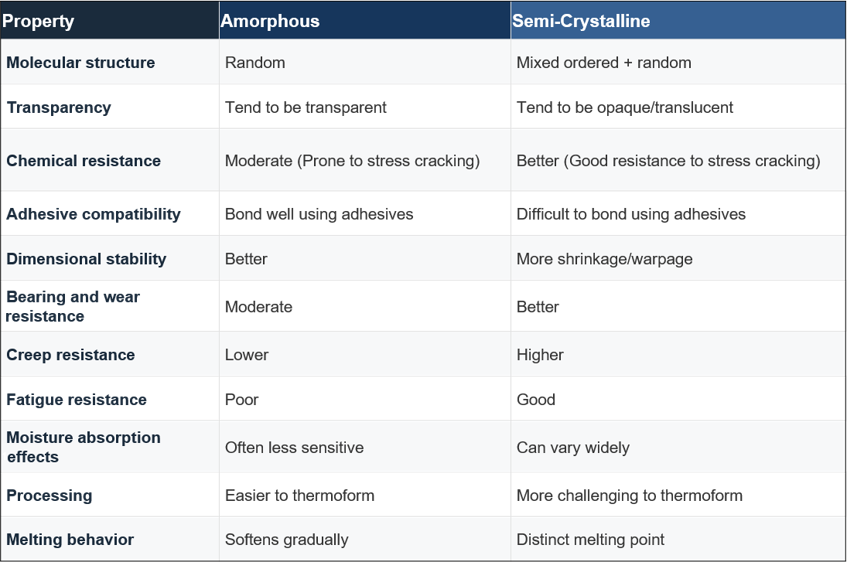
Thermal behavior is a key distinguishing characteristic between amorphous and semi-crystalline thermoplastics. Amorphous materials have a glass transition temperature (Tg), and no true melting point, and gradually soften as the temperature rises above the Tg. Semi-crystalline materials, by contrast, have both a glass transition temperature (Tg) and a melting temperature (Tm), and stay relatively stiff until they approach the melting temperature and then melt over a narrow temperature range.
- Performance vs. Cost Categories
Another way to further sub-categorize amorphous and semi-crystalline thermoplastics is by relative performance and cost, and unsurprisingly, higher performance comes at a cost. Commodity thermoplastics are widely used and are the lowest cost tier. Engineering thermoplastics are the next tier up in performance and are comparatively moderate cost. High-performance thermoplastics are the highest performing materials and command the higher cost.
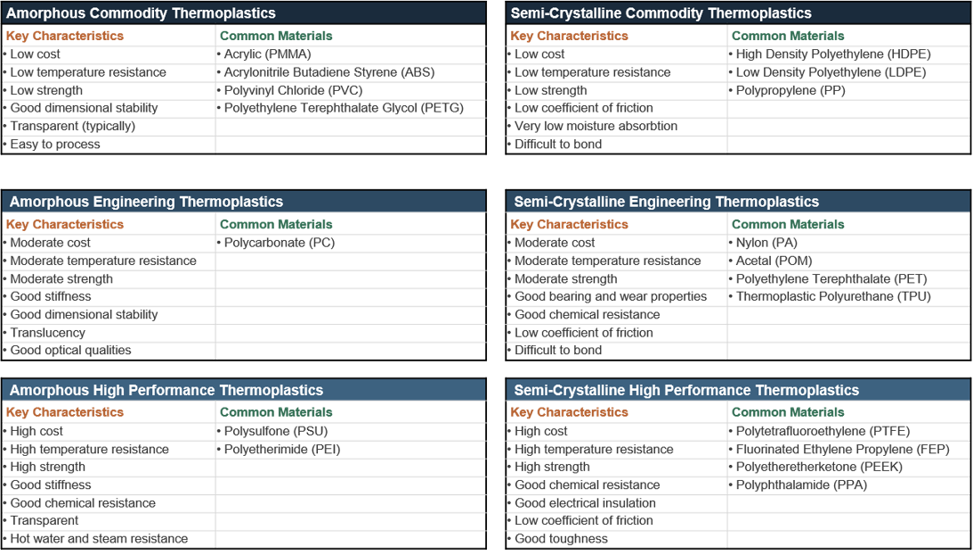
Source: IAPD Thermoplastic Rectangle
Generally, a useful approach to material selection is to decide whether amorphous or semi-crystalline material properties best match the overall functional needs, followed by evaluating performance and cost tradeoffs to land in the right quadrant.
Manufacturing Considerations
The intended manufacturing process also is a key factor in selecting materials. For example, PTFE and PEEK are both high-performance semi-crystalline medical device materials that share common characteristics like high strength, low coefficient of friction, and toughness. However, whereas PEEK can be injection molded using high-temperature heated mold tooling, PTFE does not become a free-flowing melt when heated above its very high melting point, and therefore it is typically processed by ram extrusion or compression molding followed by sintering. Different materials also possess different shrink rate ratios for injection molding which must be properly accounted for in tooling design and thermal processing to ensure dimensional accuracy in the finished part configuration. For catheter applications, relatively minor material changes such as modifying durometer or additives can influence extrusion parameters, reflow processing parameters, adhesive bonding, or coating compatibility. Manufacturing considerations should account for the full “processing lifecycle” of the material to finished product form.
Managing Design Tradeoffs
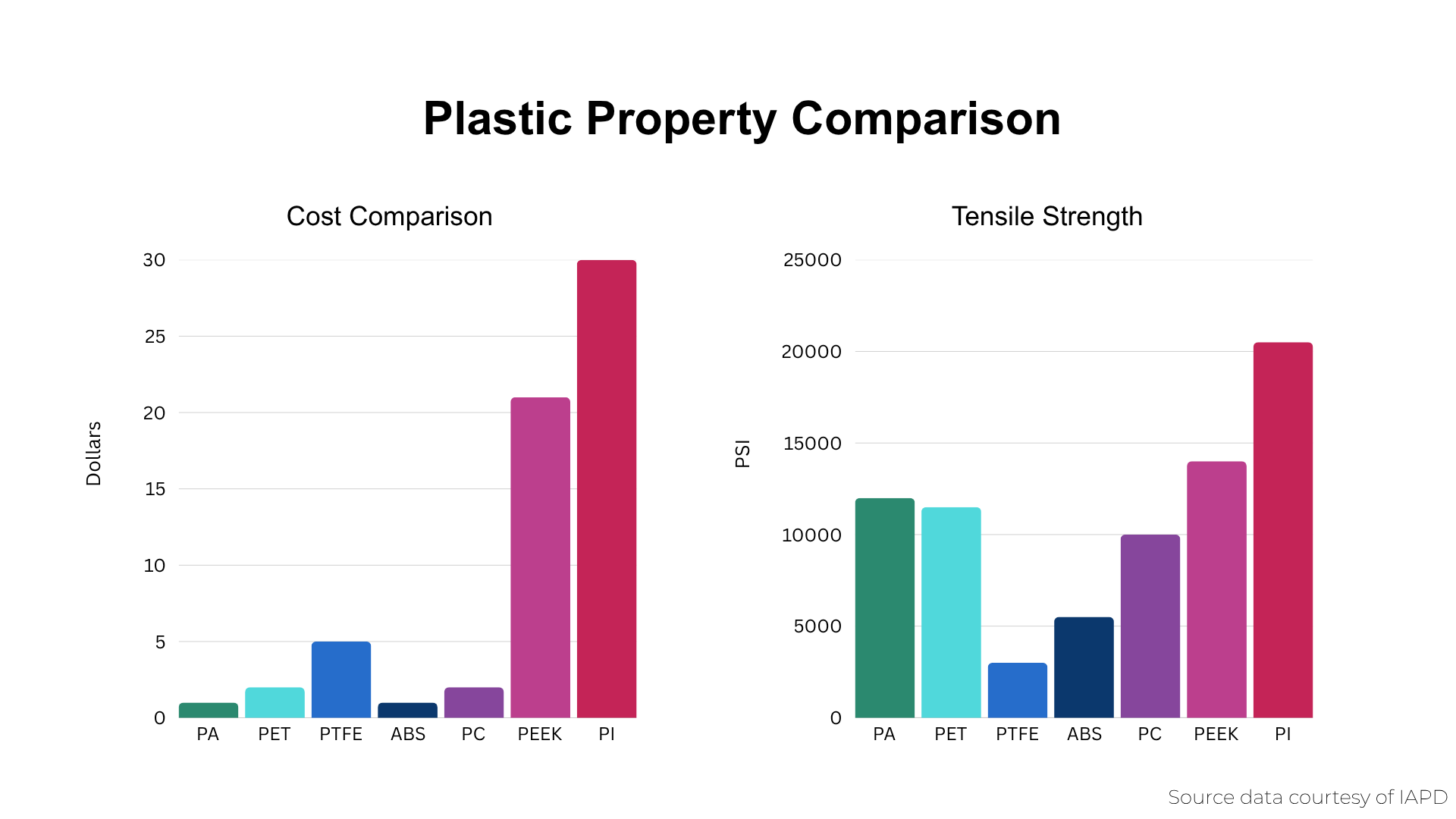
Specific material choice, down to the particular trade name and grade, often comes down to managing tradeoffs of different characteristics; mechanical, thermal, electrical, optical, chemical, and cost. ABS is an example of a widely-used commodity thermoplastic material that has moderate strength, excellent dimensional stability, is easily colored, and is very low cost. Polyimide (PI) is an example of an imidized thermoplastic that is considered an ultra-high-performance polymer due to its very high strength, superior dimensional stability, excellent electrical and thermal insulation properties, and low coefficient of friction, but all that performance comes at a premium price. Yet, it is because Polyimide is uniquely capable for many demanding interventional applications that it is widely used in medical devices, despite the high price point.
The Value of DFM
Material selection decisions are improved by bringing manufacturing engineering into material discussions early, considering the fabrication process and final assembly steps. DFM input helps avoid redesigns and delays due to impacts from late material changes and supports a smoother path to commercialization of new products.
Related Resources
.webp)
.webp)

— Connect
Your Medical Guide From Concept to Commercialization
Whether you need targeted engineering support, manufacturing process development, or a full development and manufacturing partnership, Meddux provides a modular approach tailored to your program requirements.
Connect with our team to discuss how we can support your next medical device program, from user-centered design through commercial manufacturing.
.svg)

Capabilities

Markets
Our Approach
About Us
Resources
© 2026 All rights reserved
made by
.png)