


 Resources
Steerable Catheter Design: Engineering Precision for Minimally Invasive Medical Devices
All Resoures
18 May 2026
Steerable Catheter Design: Engineering Precision for Minimally Invasive Medical Devices
Steerable catheter design is a specialized area of medical device product design and development that requires expertise in minimally invasive medical devices, interventional device engineering, and design for manufacturability (DFM). Effective steerable catheter design must balance control, flexibility, and manufacturability to support consistent clinical performance. Unlike passive shafts that rely on guidewires or the anatomy to reach a target, steerable catheters incorporate active deflection mechanisms that allow physicians to control the distal tip from outside the body. This makes it possible to reach complex anatomical regions more directly, often reducing device exchanges and improving procedural efficiency.
These devices are used in various applications including structural heart procedures for valve repair and replacement, neurovascular interventions that require navigation through small, branching vessels, urological procedures for accessing kidney stones in difficult locations, and electrophysiology procedures where millimeter-level accuracy can directly affect clinical outcomes.
The Clinical Need for Precision Control
Traditional catheter systems present clear limitations when navigating complex anatomy. A passive catheter follows the path of least resistance, guided by a wire that often must be repositioned repeatedly to reach different anatomical targets. While this can work well in straightforward pathways, it becomes far less effective when a procedure requires precise angulation or access to areas offset from the primary vessel trajectory.
Consider a structural heart procedure where a delivery system must be positioned at a specific valve annulus. Success requires not only reaching the target area, but also achieving the alignment and orientation needed for accurate device deployment. Active steering gives physicians real-time control over distal tip position, allowing adjustments without withdrawing and re-advancing the entire catheter system. The result can be better procedural efficiency, fewer device exchanges, and improved safety.
In electrophysiology, positioning accuracy is even more critical. Mapping and ablation procedures require stable electrode contact at specific tissue locations with millimeter-level precision. Steerable catheters help physicians maintain that contact while compensating for cardiac motion and differences in patient anatomy.
Steerable Catheter Design and Engineering Approach
Steerable devices require mechanisms that translate proximal user input into distal tip deflection. The design must transmit force efficiently through a flexible shaft navigating complex anatomy while remaining predictable, repeatable, and responsive.
The most common approach is pull-wire actuation. One or more thin wires run through the catheter shaft and terminate near the tip, embedded within the device wall or housed in dedicated lumens. At the proximal end, these wires connect to a handle with user controls (typically rotating knobs or thumb actuators). When the physician applies tension through these controls, the distal end bends in a predictable direction and radius.
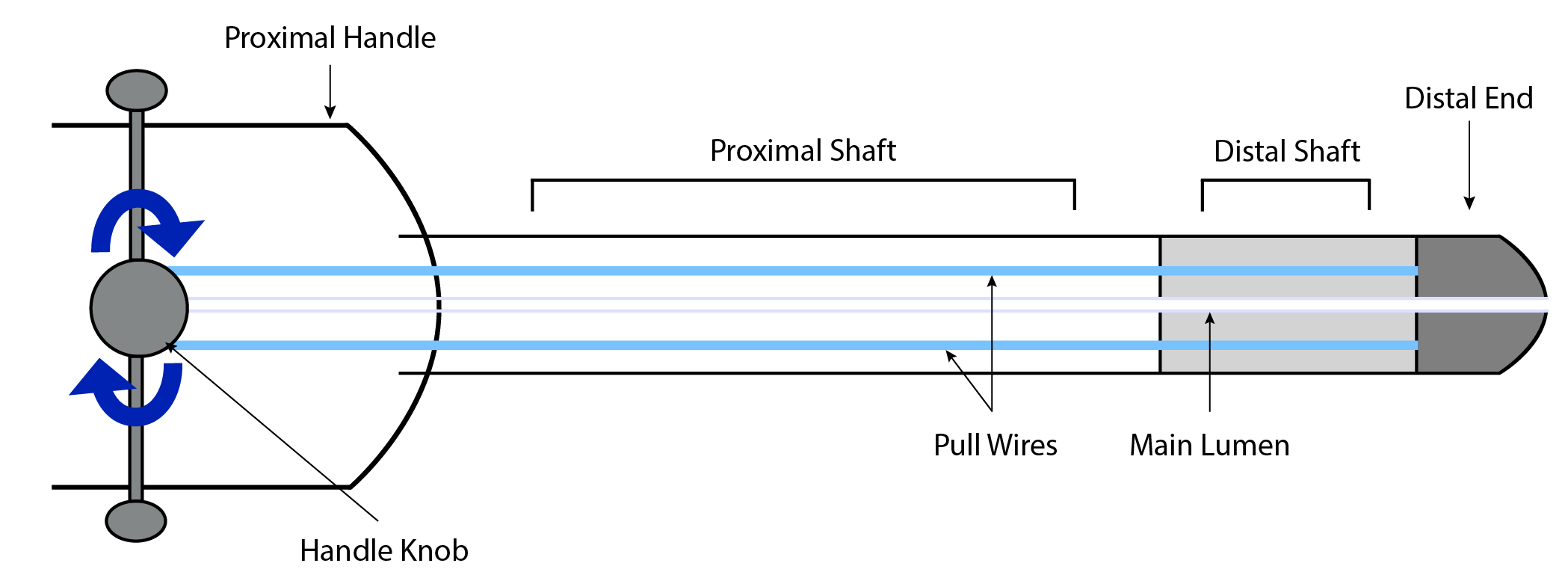
Figure 1: Pull-wire actuation system. Rotation of the proximal handle knob applies tension to pull wires running through the catheter shaft, causing controlled deflection of the distal tip.
Construction Methods
Steerable catheters require integrating multiple material layers and reinforcement elements while maintaining flexibility and structural integrity for reliable navigation and steering. Most steerable devices employ polymer shafts with embedded metallic reinforcement.
Braid and coil reinforcement are the most common approaches. Braided wire provides excellent torque transmission, push-ability, tensile strength, and high-pressure burst strength. The braid pattern, wire diameter, and density can be tuned to achieve desired performance. Coil reinforcement offers excellent flexibility, kink resistance, and crush strength. Typically, dynamic control of steerability and the resulting curvature of the catheter is dependent on designing and optimizing sections of the catheter, starting with a stiffer proximal shaft and transitioning to more flexible sections in the distal end to allow for flexure.
Laser-cut hypotubes represent another construction method with distinct advantages. Precision laser cutting creates cut patterns that result in high push-ability and column strength in the proximal shaft with controlled flexibility and radial strength in the distal steering section. Laser-cut hypotubes also allow repeatability in deflection behavior. However, they introduce manufacturing complexity, particularly when the device requires an inner liner for components or therapeutics to pass through. Ensuring proper bonding between hypotubes and inner liner while maintaining tight tolerances is challenging and demands advanced manufacturing capabilities.
Design for Manufacturability (DFM), Manufacturing Precision, and Quality Control
Steerable catheter constructions are among the most manufacturing-intensive minimally invasive medical devices. The active deflection mechanism demands extremely tight tolerances because slight variations in pull-wire diameter, lumen position, or braid density can directly affect steering behavior. Manufacturing also requires carefully controlled, sequential steps such as applying reinforcement layers, positioning pull-wires or coaxial elements, reflow bonding of polymer layers, and final handle assembly. Design for manufacturability is essential to ensure these steps can be repeated consistently during design transfer and scaled production.
Quality control extends beyond dimensional verification to functional performance testing. Deflection repeatability, tensile strength, torque transmission, and lifecycle testing identify potential failure modes before clinical use. A catheter that deflects unpredictably or requires excessive force can compromise clinical success and safety.
Human Factors and Usability Engineering
Human factors and usability engineering are also critical in steerable catheter development. Handle ergonomics, intuitive actuation, and consistent control response help physicians navigate anatomy efficiently while reducing the risk of use error during demanding interventional procedures.
Even small variations in handle feel, deflection response, or control force can affect physician confidence and procedural consistency. Designing for usability helps ensure the device performs as an intuitive extension of the user, especially in cases that demand precise movement, sustained control, and rapid adjustment.
Emerging Innovations
Steerable catheter technology continues to evolve rapidly. Current development is focused on greater precision and miniaturization, enabling access to smaller vessels and more delicate anatomy. Multi-directional steering, in which devices deflect in multiple planes simultaneously, provides physicians with greater procedural control.
Robotic-assisted catheter control represents a significant innovation frontier, offering precise, tremor-free actuation with programmable motion patterns. This is especially valuable in procedures that require sustained positioning or repetitive motions, helping reduce physician fatigue while improving consistency.
The integration of sensing capabilities is another active area of development. Force sensors at the catheter tip can provide real-time feedback on tissue contact pressure, helping physicians avoid excessive force while maintaining adequate contact. Position sensors can also support three-dimensional tracking and navigation, potentially reducing fluoroscopy time and radiation exposure.
The Intersection of Engineering and Clinical Impact
Steerable catheter technology shows how advanced engineering can address critical clinical challenges. Successful steerable catheter design must deliver predictable mechanical performance through complex anatomy, respond intuitively to user inputs, and do so within demanding size and flexibility constraints that require manufacturing precision.
When designed and manufactured well, steerable catheters can become natural extensions of physician capability, enabling interventions that expand treatment options and improve patient outcomes. Continued innovation in mechanisms, sensing, control systems, human factors, and manufacturability will keep pushing the boundaries of minimally invasive device development.
Related Resources
.webp)
.webp)

— Connect
Your Medical Guide From Concept to Commercialization
Whether you need targeted engineering support, manufacturing process development, or a full development and manufacturing partnership, Meddux provides a modular approach tailored to your program requirements.
Connect with our team to discuss how we can support your next medical device program, from user-centered design through commercial manufacturing.
.svg)

Capabilities

Markets
Our Approach
About Us
Resources
© 2026 All rights reserved
made by
.png)