


All Resoures
05 Jun 2025
Where Design Thinking Fails
What Is Design Thinking?
You’ve probably heard the term “Design Thinking,” but what is it really? What are the benefits of this approach to innovation? What are the gaps? Design thinking is a human-centered approach to solving problems. It starts by empathizing with the target user and fully understanding their environment and challenges. This requires a deep dive where it is necessary to study and redefine the problem that needs to be solved—from the user’s perspective. There is no doubt this approach is essential, but there are several common pitfalls that we tend to fall into.
Common Pitfalls: The Feature Trap
First, we need to ensure there are real problems that need to be solved and that there is an economic case for doing so. Second, when faced with solving problems, our creative minds tend to gravitate toward the latest technologies and features. Features are great, but they are easy to confuse with innovation. Adding features doesn’t necessarily solve user problems holistically. This is a significant gap within Design Thinking. In fact, adding features that users need to navigate can make the user experience worse. We must also question the business case and whether customers will pay for the added features. Instead of thinking about features, we should drive our innovation processes to focus on holistically solving problems that users face in their everyday tasks. However, we must cautiously recognize that what is a problem for you might not be a big issue for me and vice versa. Technologies and features can be exciting, but they may, in fact, add only limited benefits to select users—while also significantly increasing complexity and costs.
A Better Approach: Holistic Problem Understanding
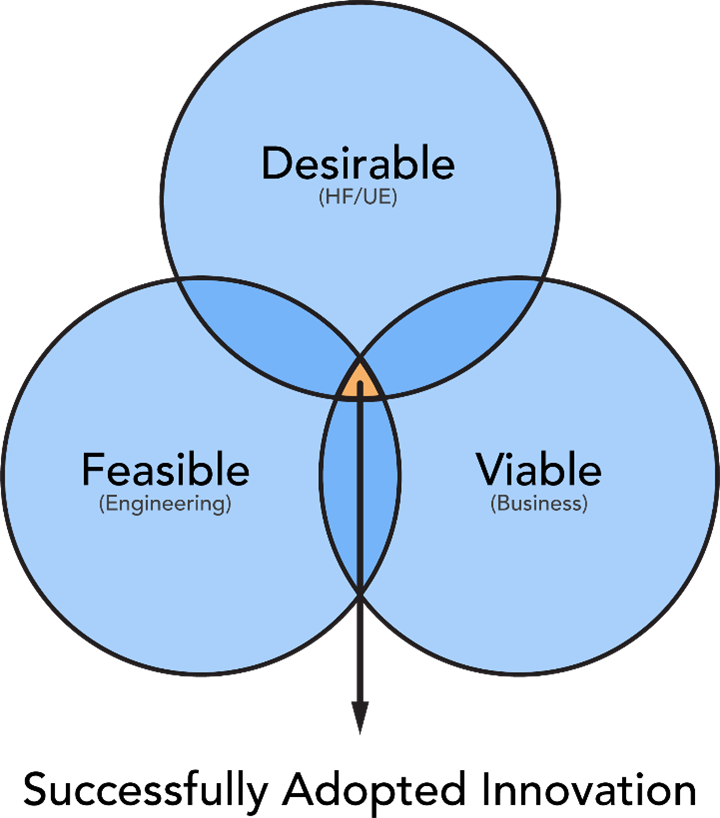
Fundamentally, more time and energy could always be spent upfront to better understand the problem we are trying to solve. This allows us to drive innovative efforts toward holistic solutions that can broadly solve user needs. We should do this with an approach that helps us better understand the entire experience and workflow. Our goal is to create a solution that is desirable (to users), feasible (for engineering), and viable (for business). This means that we need to assess not only user needs but also balance technical risk and determine whether the business case justifies the value delivered to customers.
Figure 1: Criteria for Successful Product Innovation
Related Resources
.webp)
.webp)

— Connect
Your Medical Guide From Concept to Commercialization
Whether you need targeted engineering support, manufacturing process development, or a full development and manufacturing partnership, Meddux provides a modular approach tailored to your program requirements.
Connect with our team to discuss how we can support your next medical device program, from user-centered design through commercial manufacturing.
.svg)

Capabilities

Markets
Our Approach
About Us
Resources
© 2026 All rights reserved
made by
.png)