


All Resoures
12 Sep 2025
Innovation by Analysis and Synthesis
Why Innovation Requires a Strategic Approach
True innovation usually doesn’t emerge from isolated creativity or spontaneous inspiration. It develops through systematic processes that leverage existing knowledge, identify patterns across industries, and build upon proven foundations. Understanding how to navigate the innovation journey involves recognizing that breakthrough solutions are fundamentally incremental – each advance enabling the next wave of possibilities.
Foundation: Deep Problem Immersion – Start with genuine understanding
Meaningful innovation begins with comprehensive problem exploration, which first requires proper problem framing. Complex innovation challenges often don’t have one right answer and cannot be solved analytically. Without thorough understanding of the challenge you’re addressing, solutions risk being superficial and disconnected from real needs.
Effective innovators invest significant amounts of time experiencing problems in their natural environment. They research extensively, engage with stakeholders, and immerse themselves in the complexities rather than rushing toward solutions. This foundational work helps distinguish transformative innovation from incremental improvements that miss the mark.
Methodology: Systematic Analysis – Break complexity into manageable components
Innovation can benefit from structured thinking to handle complex challenges effectively. Traditional brainstorming often generates fragmented parts or features of the whole solution. Analysis can help by breaking intricate problems into discrete, understandable elements. This process reveals the underlying functions and requirements that fragmented concepts are trying to address.
When you break down complex problems into their individual components, it’s important to generalize these discrete elements to see the bigger picture. By taking this broader perspective, you expand the potential solution set and avoid becoming trapped by premature specifics that may not withstand scrutiny.
Cross-Industry Learning – Leverage analogies and proven patterns
Some of the most powerful innovations emerge from recognizing successful patterns in adjacent fields and adapting them to new contexts. Innovation rarely starts completely from scratch – breakthrough solutions often emerge by combining existing elements in novel ways.
By studying how other industries solve similar challenges, you gain access to a broader toolkit of approaches and avoid reinventing established solutions. This analogical thinking accelerates development while reducing risk, since it builds upon methods with demonstrated effectiveness.
Integration: Strategic Synthesis – Reassemble components into cohesive solutions
The critical breakthrough often occurs during synthesis, where fragmented insights transform into integrated solutions. This stage separates effective innovators from those who generate interesting but impractical concepts.
Synthesis involves reassembling analyzed components into unified approaches that address the complete problem scope, but it requires more than simply combining parts. True synthesis calls for integrating them into a coherent whole and recognizing the underlying patterns that connect fragmented elements. This is where innovation moves beyond assembly and becomes transformation. The key is maintaining flexibility during this process, enabling rapid testing and iteration to eliminate non-viable elements efficiently.
Validation: Rapid Testing Framework – Fail fast, learn faster
Sustainable innovation benefits from efficient validation processes that separate promising concepts from flawed assumptions.
By implementing rapid prototyping and testing cycles, you can validate core assumptions early, while the cost of missing the mark remains low. This iterative approach generates genuine knowledge about what works, ultimately leading to innovations that appear effortless but are grounded in systematic development.
Embrace the Innovation Process
Successfully navigating innovation can involve recognizing it as a disciplined methodology rather than creative inspiration. By combining deep problem understanding, systematic analysis, cross-industry learning, strategic synthesis, and rapid validation, you create conditions where breakthrough solutions can emerge naturally from structured effort rather than chance.
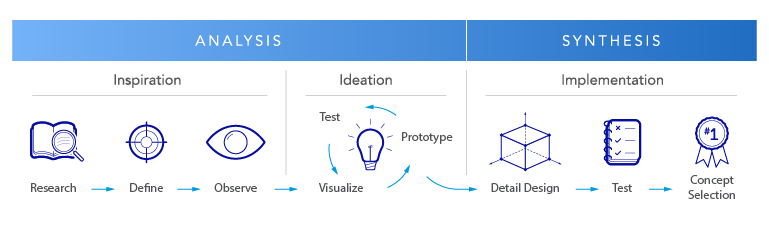
Figure 1: Concept generation
Related Resources
.webp)
.webp)

— Connect
Your Medical Guide From Concept to Commercialization
Whether you need targeted engineering support, manufacturing process development, or a full development and manufacturing partnership, Meddux provides a modular approach tailored to your program requirements.
Connect with our team to discuss how we can support your next medical device program, from user-centered design through commercial manufacturing.
.svg)

Capabilities

Markets
Our Approach
About Us
Resources
© 2026 All rights reserved
made by
.png)