


All Resoures
24 Jun 2026
Energy Therapeutics: Part III – Design Considerations
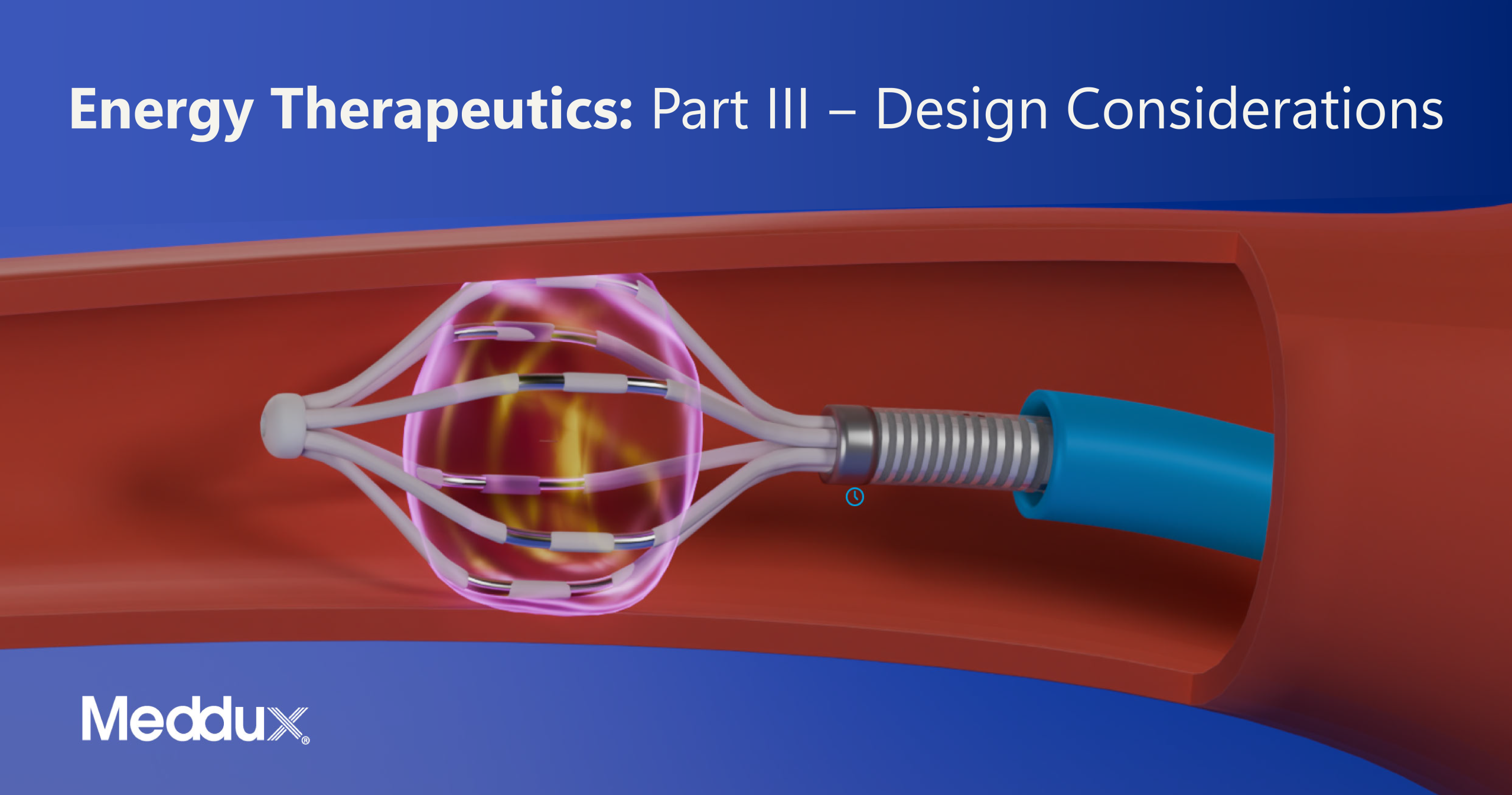
Design Considerations for RF, PFA, Microwave, and Ultrasound Systems
Introduction
Energy-based therapeutics have become foundational in modern medicine, enabling precise tissue modification across applications ranging from minimally invasive surgery to oncology and cardiac ablation. Ablation device development is foundational to modern energy-based therapeutics, enabling precise tissue modification across applications ranging from minimally invasive surgery to oncology and cardiac ablation. As discussed in Parts I and II, each modality interacts with tissue in fundamentally different ways, but all share the same engineering challenge: delivering energy safely, efficiently, and predictably to the intended tissue.
In this installment, we focus on the design considerations that ultimately determine performance, safety, and clinical outcomes across radiofrequency (RF), microwave, therapeutic ultrasound, and pulsed-field ablation (PFA) systems.
Electrical Safety: The Foundation of Every Design
Electrical safety is non-negotiable in energy-based systems. Devices must comply with internationally recognized standards such as:
- IEC 60601-1 for general electrical safety and essential performance
- IEC 60601-2-2 for high-frequency surgical equipment where applicable
- IEC 60601-1-2 for electromagnetic compatibility
Together, these standards protect both patients and operators under normal and fault conditions.
The risks these standards guard against are well known but worth restating. Patients can be burned by unintended current paths. Leakage currents can travel through parasitic conductive or capacitive pathways. Electromagnetic interference can disrupt nearby devices, and coupling effects can deliver energy where it was never intended to go.
Robust systems address these risks through layered verification and validation testing. Hipot testing checks dielectric insulation integrity under high voltage stress. Leakage current testing confirms that stray currents stay below safe thresholds. EMC and EMI testing verifies both emissions control and immunity to interference. The most effective systems do not bolt on safety at the end of development. They are designed from the ground up to prevent unintended energy delivery in the first place.
RF Ablation Device Development: Managing Impedance and Control
High frequency systems operate in a regime where complex impedance, not just resistance, defines performance. Success depends on controlling how current flows through both intended and unintended paths.
A critical design goal in RF systems is optimizing electrode design to achieve the desired clinical effect at the lowest possible power output. Lower power operation reduces collateral tissue damage, minimizes leakage and unintended coupling, and improves overall system safety margins. Electrode geometry, surface area, and material selection all directly influence current density and heating efficiency.
Dielectric Coupling and the 10:1 Rule
At high frequencies, indirect dielectric coupling introduces parasitic current paths through insulation and surrounding materials. A widely accepted design principle is to maintain at least a 10:1 impedance ratio between these indirect dielectric paths and the intended tissue path. This ensures that energy preferentially flows to the target site rather than dissipating elsewhere.
Designing for Complex Impedance (R, L, C)
High frequency systems must also be designed around complex impedance as a whole, including resistance, which governs ohmic heating, capacitance, which drives unintended coupling and leakage, and inductance, which influences reactance and transient response. Focusing solely on resistivity is insufficient. Engineers need to characterize impedance across the operating frequency range, minimize parasitic capacitance and inductance, optimize the full system rather than individual components, and confirm that conductor material is appropriate for the application.
Cable Design and Skin Effect
Cable design introduces its own set of considerations. At high frequencies, current distribution is governed by the skin effect, where current concentrates near conductor surfaces. This calls for appropriate conductor geometries, such as stranded or litz wire where applicable, along with careful attention to twist and lay configuration, which can reduce inductive reactance. Maintaining consistent impedance along the cable is critical. Cable design is often the difference between a system that performs consistently and one that suffers from loss and unintended coupling.
Microwave, Cryoablation, and Ultrasound Device Engineering: Maximizing Energy Transfer
Unlike RF systems, microwave and ultrasound modalities rely heavily on wave propagation and coupling efficiency. Efficient energy delivery depends on proper impedance matching between the generator, the transmission system, and the tissue. Poor impedance matching leads to reflected power, reduced ablation efficiency, and heating of unintended system components.
In microwave systems, antenna design directly controls the ablation profile. Antenna geometry determines the radiation pattern, while chokes and baluns help isolate energy and prevent shaft heating. Proper design minimizes backward radiation and unintended tissue damage. Many microwave systems also incorporate active cooling, which prevents overheating of the applicator shaft, enables higher power delivery, and improves control over ablation size and shape.
Therapeutic ultrasound introduces its own set of design factors. Acoustic impedance matching is critical for efficient transmission, transducer performance determines delivered energy, and focusing controls treatment precision. Designers must also account for thermal effects and mechanical effects, including cavitation.
Pulsed Field Ablation PFA Systems and Electroporation Device Development
PFA represents a fundamentally different design paradigm, using high electric fields rather than heat to achieve tissue ablation. Typical systems operate around 1 to 2 kV, with some exceeding 5 kV, and 20 to 60 amps of current, delivered in pulses lasting from microseconds to milliseconds. This combination of high field strength and short pulse duration enables electroporation while limiting thermal damage.
A key engineering challenge in PFA design is properly sizing conductors for these short-duration, high-voltage, high-current pulses. Unlike steady-state systems, PFA systems experience high peak electrical stress over extremely short pulse durations, which makes thermal effects transient rather than continuous. Traditional RMS-based design methods fall short here. Instead, designers need to characterize energy per pulse, repetition rate, and duty cycle, evaluate instantaneous current density and transient heating, and ensure insulation can withstand peak voltage and rapid dv/dt transitions.
Beyond conductor sizing, PFA design also demands precise waveform and timing control, electric field shaping through electrode geometry, and mitigation of unintended field exposure. PFA reduces the risk of thermal injury, but it introduces new challenges around high-voltage safety, transient behavior, and EMC performance.
Conclusion
Across all energy modalities, successful systems share a common foundation. Energy delivery must be controlled and efficient. Safety must be engineered into the design rather than validated at the end. Complex impedance governs system behavior, and mechanical, electrical, and thermal design are deeply interconnected.
Whether optimizing an RF electrode, tuning a microwave antenna, advancing electroporation device development, or managing high-voltage PFA pulses, the fundamental goal of ablation device development remains the same: deliver the right energy, to the right place, with the highest level of safety and consistency.
As energy therapeutics continue to evolve, the most effective solutions will combine deep physical understanding with disciplined engineering and an unwavering focus on patient safety.
Related Resources
.webp)
.webp)

— Connect
Your Medical Guide From Concept to Commercialization
Whether you need targeted engineering support, manufacturing process development, or a full development and manufacturing partnership, Meddux provides a modular approach tailored to your program requirements.
Connect with our team to discuss how we can support your next medical device program, from user-centered design through commercial manufacturing.
.svg)

Capabilities

Markets
Our Approach
About Us
Resources
© 2026 All rights reserved
made by
.png)