


All Resoures
12 Dec 2025
Design Firm vs. D&D vs. CMO vs. CDMO: What's the Right Fit?
Design Firm vs. D&D vs. CMO vs. CDMO: How to Choose the Right Medical Device Partner.
Bringing a new medical device to market is a significant undertaking, and effective partnerships are key to help you navigate it. Even well-resourced organizations face limits in time, capacity, or specialized expertise. As a result, external partners are often a practical and cost-effective way to move faster with less risk.
Choosing the right partner can be the difference maker. But which partner is the right fit and the right time? To answer that, it helps to understand the common business models, and the acronyms that come with them.
Design Firm
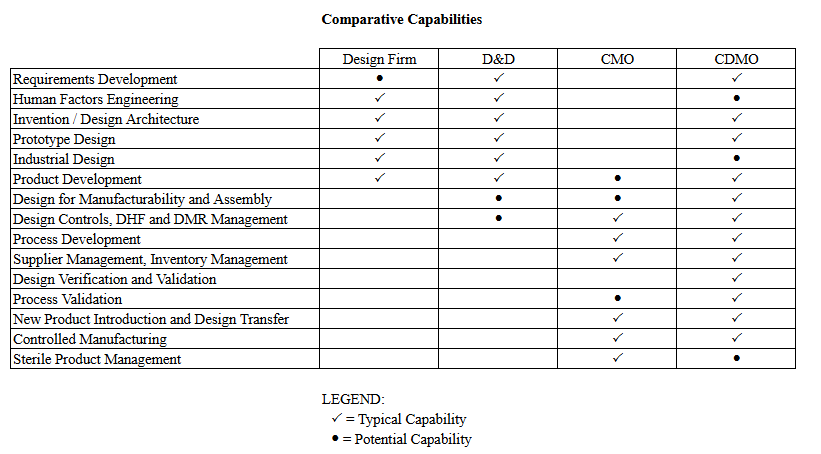
Design firms typically have several technical focus areas, such as industrial design, mechanical engineering, electronics (hardware and software engineering), prototyping, and/or user testing. They often excel at early concept development, user-centered design, and rapid prototyping.
Design & Development (D&D) Organization
A design and development (D&D) organization builds on the strengths of a design firm and adds DFX expertise. In other words, they help ensure the device is not only functional and usable, but also ready to be built reliably.
For example, Design for Manufacturing (DFM), Design for Assembly (DFA), and Design for Reliability (DFR) translate product intent into practical, repeatable production. In addition, these organizations usually staff engineering, quality, and project management to support the full development cycle.
Contract Manufacturer (CM / CMO)
Many OEMs seek external partners to take ownership of ongoing manufacturing of their product. Contract Manufacturers may produce components, value-added subassemblies, or finished goods.
However, design support varies widely. Some offer broader design and development services, while others focus on Design-for-Manufacturing and Assembly (DFMA) for their specific processes. Still, others are strictly build-to-print with no design services.
In practice, CMs are the hidden engine behind many product companies. They stand out through operational excellence and consistent quality, both essential in medical device manufacturing.
Contract Design, Development, and Manufacturing Organization (CDMO)
A CDMO supports the medical device lifecycle end to end. That can include user-centered design, detailed product development, processes development, and finished device manufacturing.
As a result, CDMOs often combine the strengths of a D&D partner with the capabilities of a contract manufacturer. They can help reduce handoffs between vendors and keep accountability clear as the program scales.
Clarifying Definitions
These categories are helpful to understand the broad classifications of third-party contract organizations, but there is still plenty of overlapping “gray-zones” between them.
First, “Design” can mean different things depending on the context. It can range from truly conceptual design that frames product architecture, to highly specific optimization for a manufacturing process such as metal stamping or injection molding.
“Manufacturing” can range from component fabrication to non-sterile subassembly to sterile finished goods. It can also describe high-mix/low-volume new product introduction or low-mix/high-volume steady-state production.
Finally, “development” is the in-between work that matures a concept into a manufacturable product. For example, it spans concept selection through verification and validation planning and execution.
Clarifying Questions
There are several crucial decisions to make when considering a contract partner, such as:
- Will you own the design internally, partner externally for contract design services, or collaborate with a design partner as an extension of your internal team?
- Will you manufacture the product internally, or partner externally for contract manufacturing?
- If you decide to partner externally for design and/or manufacturing, who will be responsible for the development work required to successfully mature the design into readiness for manufacturing?
Answering these questions effectively comes down to being very specific about lining up your needs with the capabilities of the contract partner, focusing on Processes, People, and Physical Assets – we’ll call them the 3 P’s:
Processes
What processes will you gain access to through a contract partnership? Typically, the Quality System an its standard processes form the foundation for everything a contract partner does. When the Quality System is strong, work moves more predictably and issues surface earlier.
For example, if usability must lead the design, confirm the partner has a user-centered design process. If you need concept generation, ask about their concept development approach. Likewise, if the product needs a redesign for manufacturing, assembly, or value, look for strong DFMA tools and methods.
In addition, critical processes may include risk management, equipment qualification, process validation, design verification testing, usability validation, and sterilization validation. Choose a partner that can take you from your starting point to the target endpoint without running into a capability gap.
People
People are an organization’s most valuable asset, and strong teams have clear areas of expertise. Start by listing the technical disciplines your program needs. Then confirm your contract partner is aligned to those needs.
For instance, many CMs excel in manufacturing engineering, quality engineering, and process engineering. However, they may be less focused on early concept generation and new produce development. By contrast, design firms often shine in industrial design, prototyping, and usability, but may have limited depth in DFM, design for reliability, and manufacturing process development.
CDMOs will typically focus on specific technical disciplines. The skillsets required for hand-held sterile therapeutic devices are different from capital equipment or medical electronics. Therefore, review each partner’s core competencies and look for strong alignment with your product and regulatory needs.
Physical Assets
What physical assets will you access with you selected partner? This includes facilities, equipment, capacity, warehousing, and manufacturing space. Location can matter too, especially for collaboration and logistics.
For example, assets may include ISO class-8 or better cleanrooms for sterile manufacturing or “white-room” space for non-sterile builds. They may also include engineering labs, test environments, and pilot lines for development work.
In some cases, partners also have in-house fabrication like machining or injection molding. Others have specialized assembly equipment for catheters, such as braiding, coiling, laminating, and tipping. Ultimately, the goal is to match assets to your program needs to improve efficiency and time to market.
The Right Fit
Ultimately, the “right fit” comes from matching your project lifecycle to the right business model. Then, evaluate how well the partner’s processes, people, and physical assets fit your product needs. When those line up, you can de-risk the program and move to market faster. Bringing new medical technology solutions to patients is a team sport, and working with great partners is the key to success.
Related Resources
.webp)
.webp)
— Connect
Your Medical Guide From Concept to Commercialization
Whether you need targeted engineering support, manufacturing process development, or a full development and manufacturing partnership, Meddux provides a modular approach tailored to your program requirements.
Connect with our team to discuss how we can support your next medical device program, from user-centered design through commercial manufacturing.
.svg)

Capabilities

Markets
Our Approach
About Us
Resources
© 2026 All rights reserved
made by
.png)